
New research published from the Department of Biotechnology, College of Life Sciences

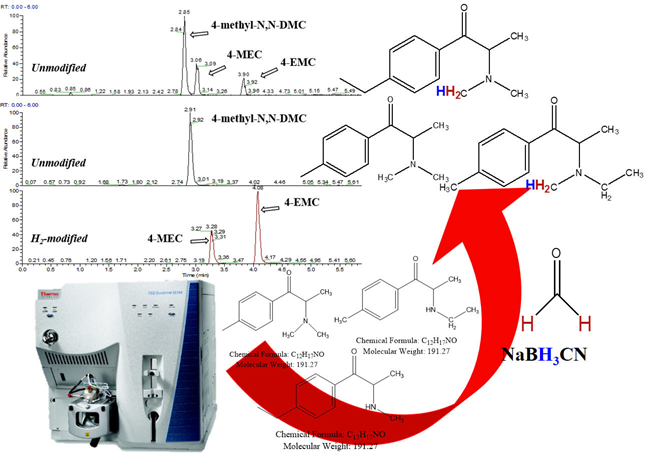
Reductive amination–based quantification of synthetic cathinones (4-MEC, 4-EMC and 4-methyl-N,N-DMC) by HPLC–MS/MS
Tsai-Hui Duh, Po-Tsun Shen, McDelvin Senida Barcolleh, Ting-Chen Chou, Yi-Ching Lin*, and Shih-Shin Liang*
Results in Chemistry 2026, 29, 103662
https://doi.org/10.1016/j.rechem.2026.103662
Cathinone is a naturally occurring β-ketoamphetamine alkaloid found in Catha edulis (Khat) and is known for its amphetamine-like stimulant effects. It has also served as the structural prototype for numerous synthetic cathinone derivatives. Synthetic cathinones, often referred to as “bk-amphetamines,” are widely abused New Psychoactive Substances (NPS) designed to mimic the effects of ecstasy, cocaine, and amphetamine-type stimulants. In this study, three cathinone derivatives–4-methylethacathinone (4-MEC), 4-ethylethcathinone (4-EMC), and 4-methyl-N,N-dimethylcathinone (4-methyl-N,N-DMC)–were synthesized via reductive amination, a well established technique for forming C–N bonds by reacting aldehydes or ketones with amines in the presence of a reducing agent. Using isotopic formaldehyde reagents (H2- and D2-formaldehyde) and sodium cyanoborohydride (NaBH3CN) as the reducing agent, isotopically labeled derivatives were generated to serve as standards and internal standards (ISs). The developed LC-MS/MS method enabled accurate qualitative and quantitative analysis of the three cathinone derivatives. Well-defined precursor ions were observed at m/z 206 for H2-labeled compounds and m/z 208 for D2-labeled analogs, with corresponding product ions confirming their structural identities. Optimized MRM transitions were established for both 4-MEC and 4-EMC. Calibration curves demonstrated excellent linearity over the range of 1–1000 ng/mL, with coefficients of determination (R2) ranging from 0.9971 to 0.9993. The limits of detection (LOD) and quantification (LOQ) were low, ranging from 1.61 to 3.59 ng/mL and 3.37–8.05 ng/mL, respectively. Average recoveries for derivatized 4-MEC and 4-EMC ranged from 90.38% to 109.02%, demonstrating high analytical accuracy and reproducibility.