KMU Biotechnology Collaborates with HKUST and CHUMT on HerboChip®-Based Regenerative Medicine Research
8/18/2026
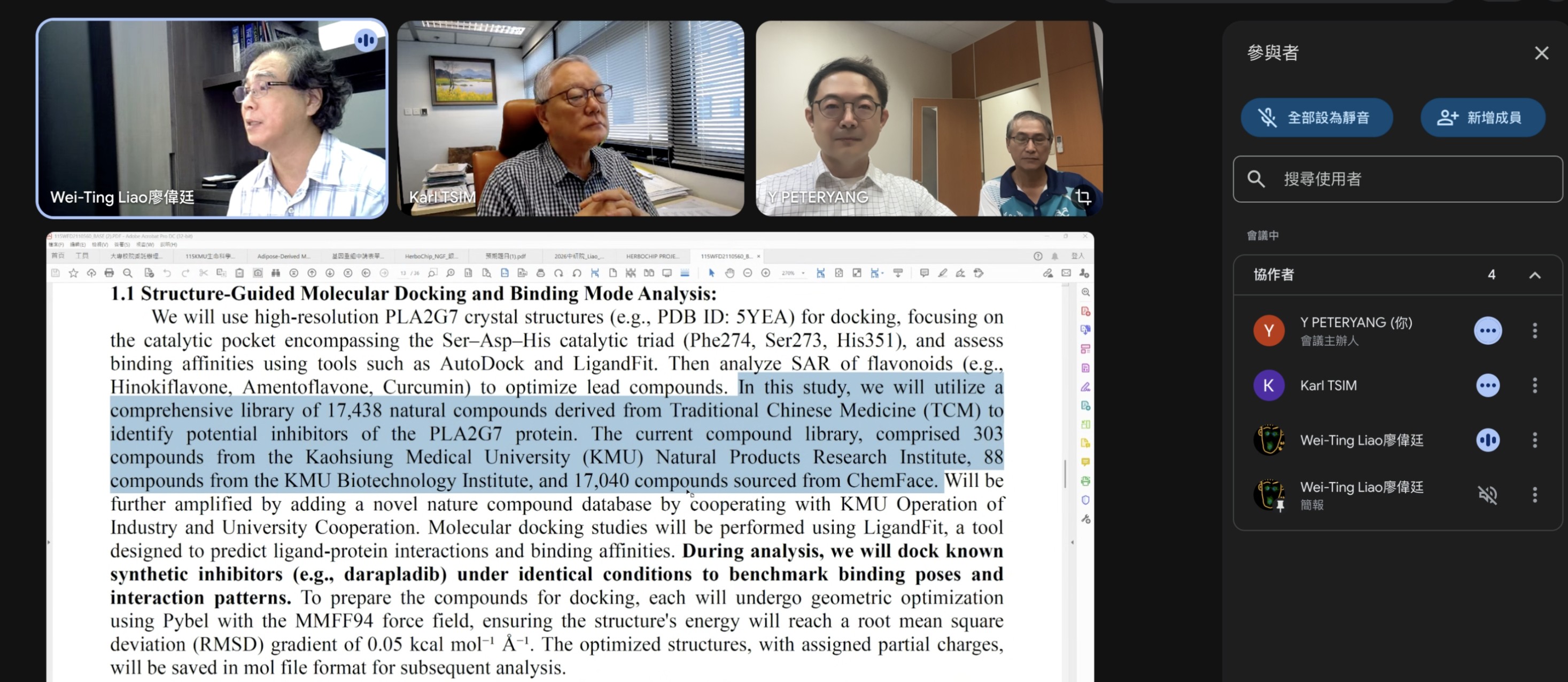
Professor Wei-Ting Liao of the Department of Biotechnology, Kaohsiung Medical University; Professor Yu-Lin Yang, jointly appointed by Chung Hwa University of Medical Technology and the Department of Biotechnology at Kaohsiung Medical University; and Professor Karl Wah-Keung Tsim, the original developer of HerboChip® at the Center for Chinese Medicine, The Hong Kong University of Science and Technology (ranked 33rd globally in the 2027 QS World University Rankings), are jointly advancing a research collaboration on HerboChip®-based natural product screening and functional validation in regenerative medicine.
During an online meeting, the three research teams discussed plans to integrate standardized herbal extraction, fine HPLC fractionation, HerboChip®-based target screening, mitochondrial functional analysis, and validation using mesenchymal stem cells (MSCs) and regenerative medicine models. This collaboration aims to establish a comprehensive technological pipeline spanning natural product screening, cellular functional assays, and molecular mechanistic studies, while promoting Taiwan–Hong Kong research training and the development of an international collaborative platform.
The project will incorporate the original HerboChip® technology and expertise of the Center for Chinese Medicine at HKUST into the College’s featured research program led by the Department of Biotechnology, “An Induced Pluripotent Stem Cell–Based Cross-Disease Platform for Precision Medicine.” The collaboration will include technical guidance and promotion of HerboChip® and will establish an integrated workflow encompassing standardized herbal extraction, fine HPLC fractionation, HerboChip®-based target screening, and cellular and molecular validation. Plant-derived extracts will be screened to identify candidate compounds capable of enhancing mitochondrial activity, followed by evaluation of their potential applications in MSC research and regenerative medicine.
In addition, the collaborating institutions will jointly promote training and academic exchange among undergraduate and graduate students and early-career researchers from Taiwan and Hong Kong. Given the historical and academic significance of HerboChip®, the collaboration will continue to involve the Center for Chinese Medicine at HKUST and will seek to establish an international platform integrating HerboChip®-based screening with functional validation in regenerative medicine.